
Technology
Are more megapixels a better camera?
Resolution has become the one thing people check when choosing a surveillance camera. The size of the space, the lens and the mounting usually matter more.
Resolution has become the one thing people check when choosing a surveillance camera here: 4MP must be better than 2MP, and that is the end of it. So let us look at what actually happens.
Resolution and the size of the space
The two are directly related. In a small space, the difference in resolution is likely to show very little. And which point the camera is focused on depends on the focal length of the lens it carries.
A 2MP (1080p) camera suits a small space — roughly 40 m². In a classroom, a kindergarten or an office it gives a picture of good enough quality, and it gives all the information security and monitoring need.
Recognising a face is not only about megapixels
Even a 2MP camera will show a face clearly if it is mounted in the right place at a suitable angle.
For example, the field of view of a 2MP camera with a 2.8 mm lens (90–100°) shows a face within three to five metres very clearly — perfect for a classroom, a corridor or the area around an entrance.
Field of view and mounting matter more
A camera with a 2.8 mm lens, mounted at 2.5 metres, covers a width of 10 to 12 metres at a distance of five to six. In a small space an arrangement like that shows a face clearly even from a 2MP camera, which is the proof that high resolution is not what was needed.
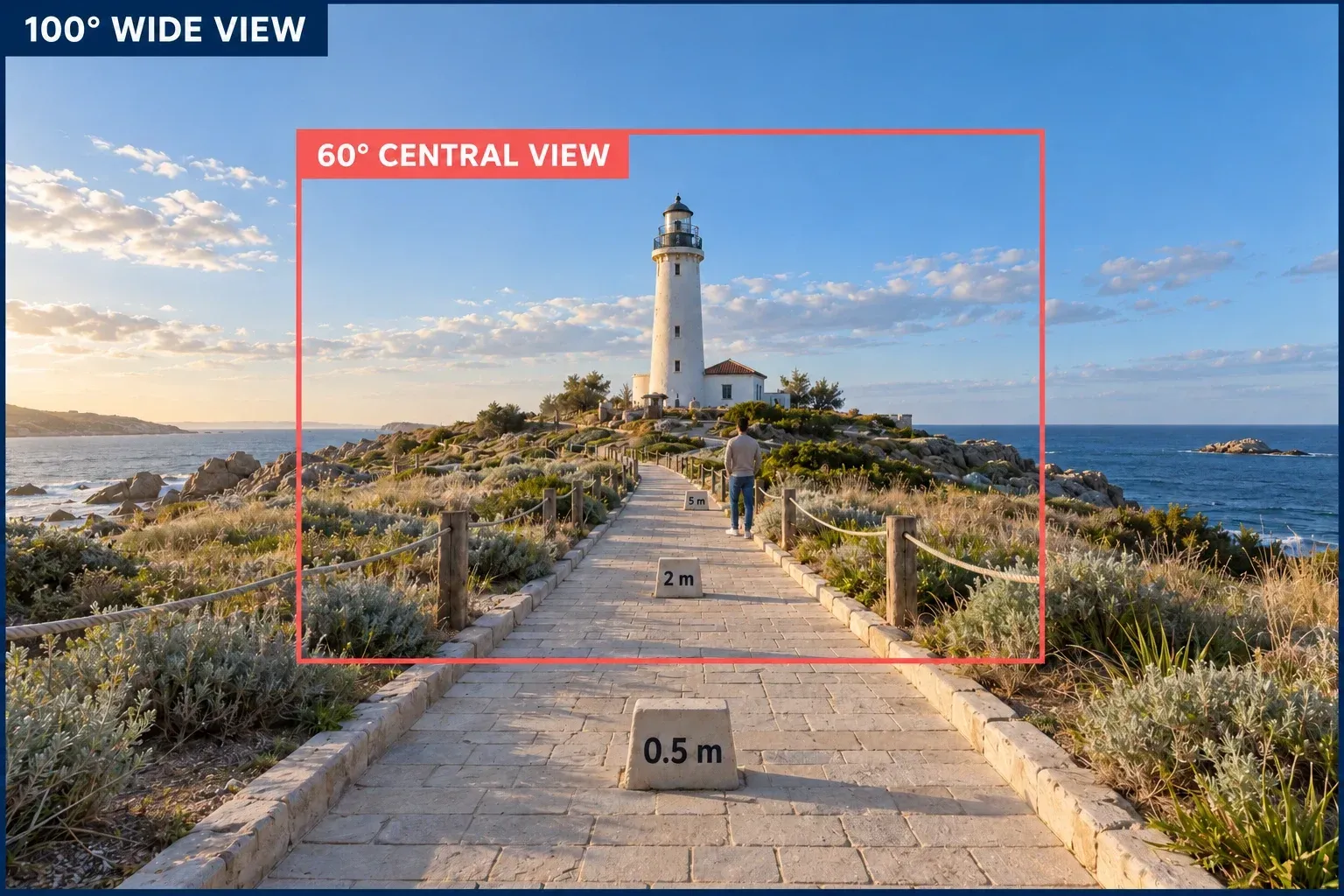
The focal length of the lens settles the angle it sees. What can be made out at a given distance is settled by the angle, the resolution and the task together.
Below is that worked out for a 2MP camera, 1920 px across — the furthest distance at which the criterion in each column heading is still met. The sums take the eyes as about 65 mm apart and a number plate as about 520 mm wide.
| Lens | Angle | Face · 22 px | Plate · 150 px |
|---|---|---|---|
| 2.8 mm | 100° | 2.4 m | 2.8 m |
| 3.6 mm | 85° | 3.1 m | 3.6 m |
| 6 mm | 60° | 4.9 m | 5.8 m |
| 8 mm | 45° | 6.8 m | 8.0 m |
| 12 mm | 30° | 10.6 m | 12.4 m |
| 16 mm | 20° | 16.1 m | 18.9 m |
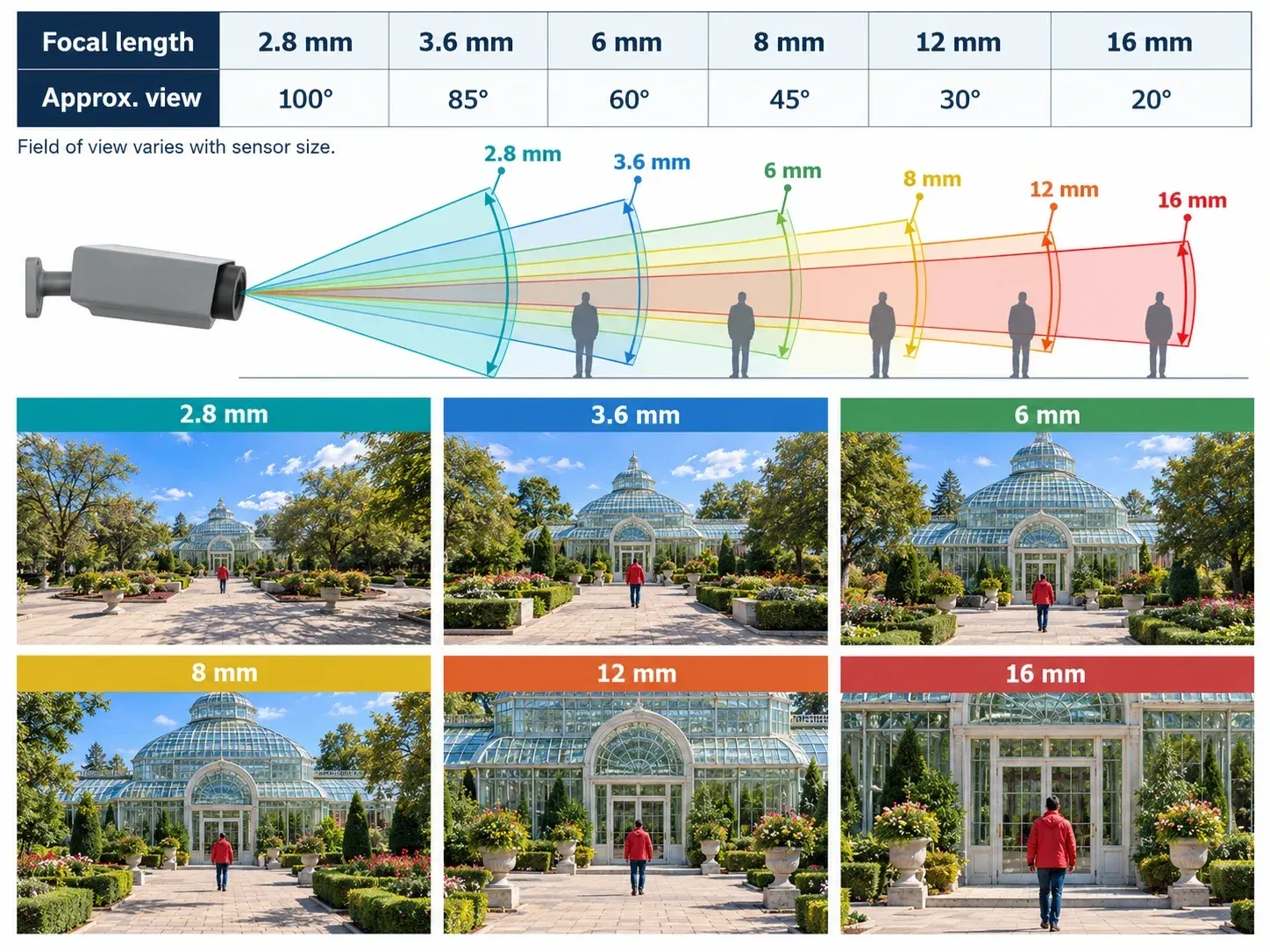
Three things come out of that table.
First, a number plate can be read from further away than a face can be recognised. A plate is eight times wider than the gap between someone's eyes, so the same count of pixels lands on it from further off.
Second, adding resolution does extend the distance, but not by as much as people expect. Pixels are counted by area, so the distance grows only with the square root: from 2MP to 4MP is about 1.3 times, and to 8MP twice. Not four times.
Third, these are thresholds for analytics. A person watching a screen needs far fewer pixels to recognise someone they know than an algorithm does — so "there is a person on the camera" is not the same as "the analytics can identify a face".
Give each camera one job
Put up one camera and it will not see everything perfectly. Each camera has its own purpose.
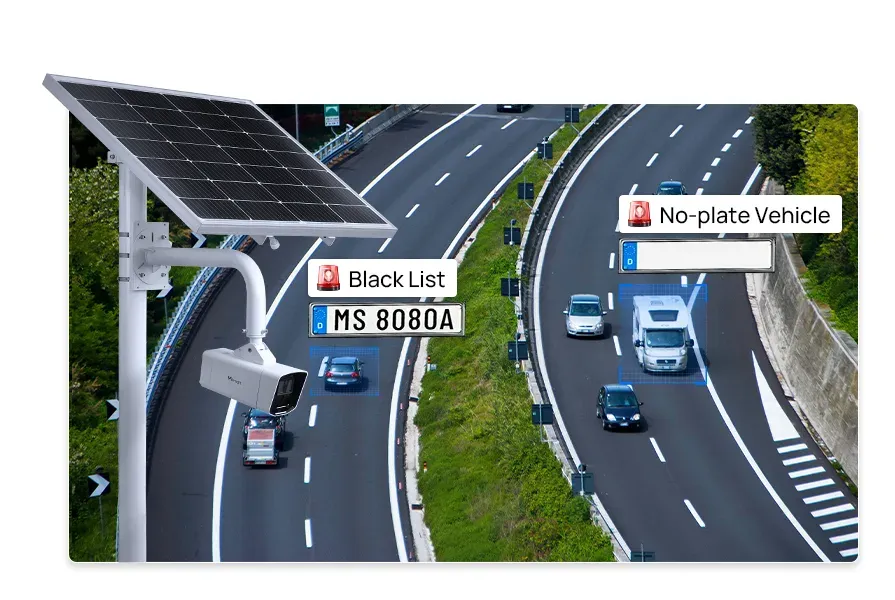
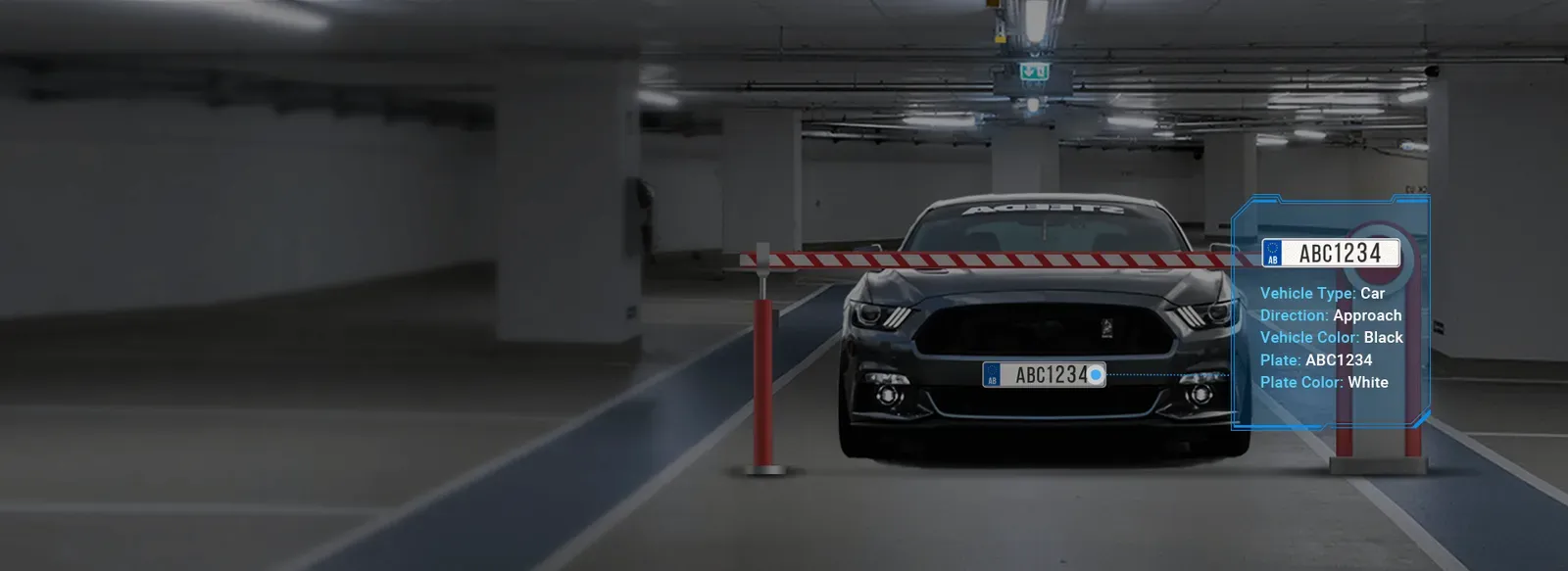
LPR — reading vehicle number plates — usually uses a 2MP camera with a narrow lens, concentrating on the plate and nothing else. For face recognition analytics, what counts is how many pixels the face is given: at least 22 pixels between the eyes, and for a number plate, 100 to 150 pixels across the width of the plate.
What it costs to buy, and what it costs to run
Keeping and carrying a higher-resolution picture costs more, and the camera itself costs more too. The decision to add resolution does not end at the price of the camera: storage and network load follow it.
This does not have to be guessed at. What a recording takes up depends on three things only — the bitrate, the retention period and the number of cameras:
Storage = bitrate × time × cameras ÷ 8
One camera recording continuously at 1 Mbps takes 10.8 GB a day (1 ÷ 8 × 86,400 seconds).
| Resolution | Bitrate (input) | One camera / day | 100 cameras / 30 days | Ratio |
|---|---|---|---|---|
| 2MP (1080p) | 2 Mbps | 21.6 GB | 64.8 TB | ×1 |
| 4MP | 4 Mbps | 43.2 GB | 129.6 TB | ×2 |
| 6MP | 6 Mbps | 64.8 GB | 194.4 TB | ×3 |
| 8MP (4K) | 8 Mbps | 86.4 GB | 259.2 TB | ×4 |
What the table is really showing is not the particular figures but the ratio: double the bitrate and you double the recording. Going from 2MP to 8MP turns 65 TB into 259 TB, and that difference arrives in the budget three times over — in disks, in the server, and in what the network has to carry.
There are ways to bring it down: a shorter retention period, recording on motion, a leaner secondary stream, or simply a lower bitrate. The simplest one is choosing the resolution the space actually needs.
In short
“More is better” is worth resisting
Before buying a 4MP camera, work out the size of the space you are watching, where the camera should sit, and what the recording will cost to keep. In most small spaces — classrooms, kindergartens, offices — a 2MP camera shows a face clearly and keeps the place secure, at a lower price. Choose the camera that fits the space.
We can work out which resolution, which lens and which mounting position suit a particular space.